
Friday Favourite #20
In the great green room...

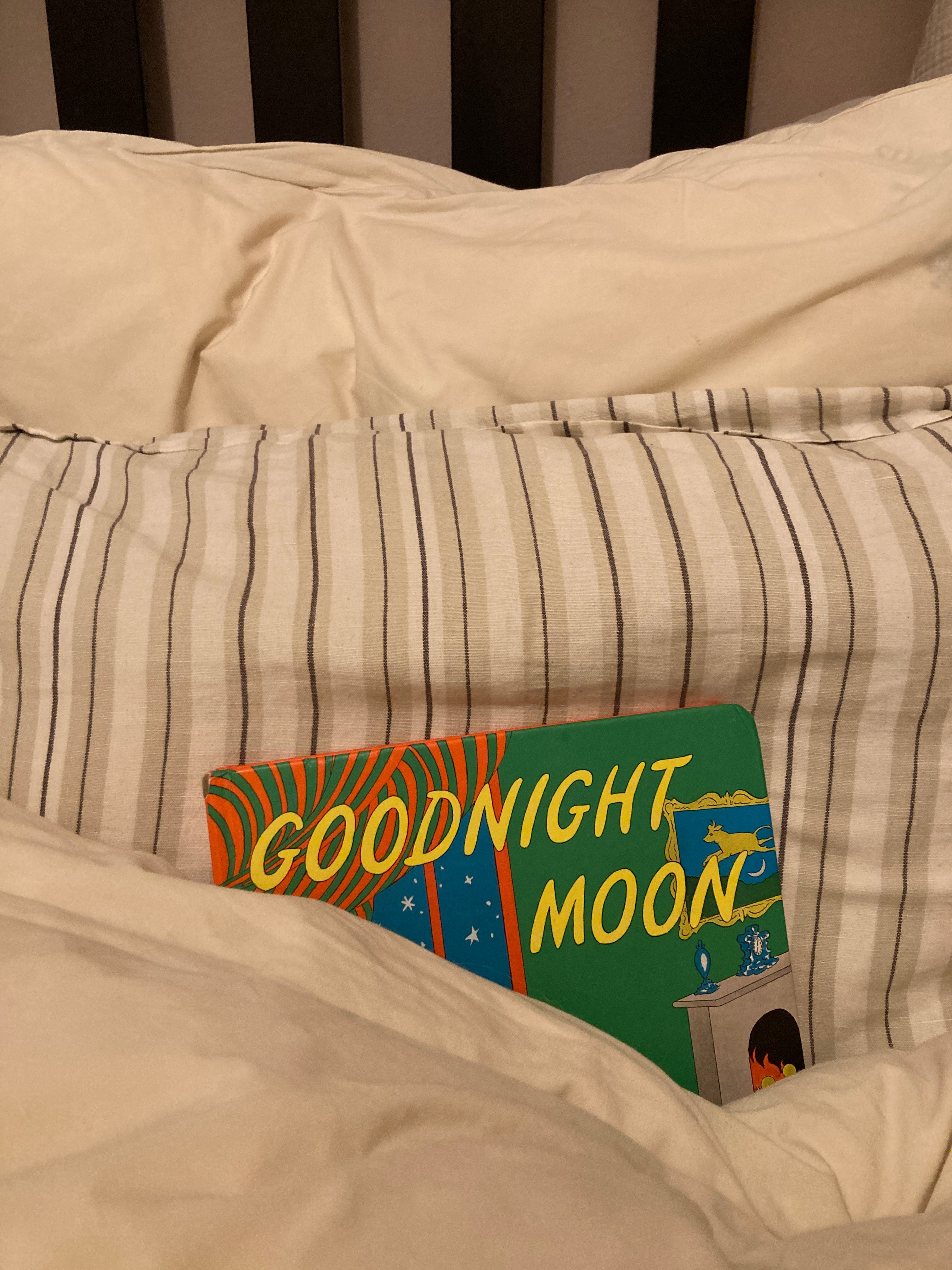
Hello, Friends. The clocks went forward in this part of the world last weekend, which means our evenings are extra light and bright. As parents of any stripe will know, honouring daylight savings in either direction presents a riddle within a box within a prison within a cage of impossibility because time is a social construct and your kids just wake up whenever they goddam please anyway. But when we spring forward, as it were, we also have to tempt our feral creatures into bed come the evening whilst the daylight continues to pour in around the edges of their curtains. It’s a doozy. So this week my mind has turned to storytime again, and the kinds of trippy and insane pleas we make for sleep to take us all. That’s right, friends, it’s time for GOODNIGHT MOON, by Margaret Wise Brown and Clement Hurd.
I suppose most of us picture the writers of children’s books as comely and soft, tinkering about with drawings of animals and cycling to the library. Or maybe that’s just me. In any case, Margaret Wise Brown seemingly ate comely writers for breakfast, as this fantastic The New Yorker profile attests. Notwithstanding the fact that she spent her entire book advances on Chrysler convertibles and ocean liner trips, wore wolfskin and hunted rabbits, and maintained tempestuous romances with men and women, she wrote a prolific number of fantastical children’s books until her untimely death aged 42. Even her passing was theatrical—the day she was due to be discharged from hospital following a routine operation, she kicked up her leg into a can-can to demonstrate her ruddy good health to the medical staff, but dislodged a blood clot, passed out and died. Her gravestone declares her a “Writer of Songs and Nonsense”. She wrote it herself, of course.
Songs and nonsense goes some way to describing the content of Goodnight Moon, that phenomenally successful and much-parodied book from 1947 which begins with a scene from a surrealist painting and never lets up. There is no plot in this hallucinatory story, just a series of abstract rhymes as a rabbit prepares for bed. Brown was a disciple of an experimental teaching school called Bank Street, and was recognised early on for her penetrating use of poetic language over any apparent classroom skills. She quickly forged ahead with what was called a ‘Here and Now’ style of writing that was based on social observation of children, and a rejection of the belief that the only stories suitable for kids were chock-full of morals.
Apparently Brown was particularly interested in understanding the minds of five-year-olds. Me too, girl! My own five-year-old is an enigma that both my husband and I try—and repeatedly fail—to crack, as she leaves us folding ourselves into contortions trying to see her specific view of the world. She just doesn’t live on the same astral plane as us right now, and you know what? Fair fucking dos. Before long, logic and reason and hormones and society will drag her back to this world and she’ll have to follow a complete thought from A to B and reckon with the consequences. She may as well enjoy the nonsense for now.
Goodnight Moon appeals to the palpable existence of here and now that young children, like my daughter, particularly enjoy. It’s a sparse book, which makes it feel cut to the quick—there’s no cloying overtones to this bedtime ritual, but the naming of everyday objects feels so soothingly domestic and soporific. And in the space between the lines—between the bidding goodnight to combs and mittens and bowls of mush—there is a feeling of fond finality to the day. After all, Brown herself said “How can you have the here and now without an emotion?”
You can follow the surrealism a little too far, or try to find depth of meaning to lines like “goodnight nobody” which are creepy as hell. The Guardian writer Stuart Heritage once posited that the whole thing has the aura of a murder-suicide, especially seeing as we’re all bidding goodnight to air by the end. But the kids love it. It’s right on their level. It’s not a gussied-up parable or fairy tale or learning opportunity, it’s just verse from whatever part of the cosmos they travelled here from.
These days I read it to our son, and he slaps the book with his chubby starfish hand or points at various parts of the fever dream spilling out over the pages with a tiny pointer finger. BAhhhHHHhhh! he tells me. I know, I reply—it’s a trip, isn’t it, kid? And then we walk around the apartment saying goodnight to his daddy and his big sister and the cat, tracing our way through the same bedtime ritual before I lay him down in his cot. His body remembers that it’s time for bed more readily than his mind, as he rubs his eyes the minute we enter the soft cocoon of his room, despite his mewling protests.
How many of us, now adults, have forgotten how to go to bed? If we were lucky in our childhood, we had parents who helped us wind down from the day and get ready for sleep with well-placed routines and a metaphorical and literal dimming of the lights. I remember the pang of sadness that accompanied the prospect of sleep because it meant saying goodbye to the people I loved. There are many things we may choose to do alone despite being offered company, but sleep provides no alternative—even if you share a bed with ten others, you must walk into oblivion solo. I think children know that better than anyone. It confirms their need to be accompanied as far as possible, and to honour the people and objects who will be there to greet them the next day.
We can learn a lot from this. Too many of us fail to hold any space around bedtime for meaningful rituals. We clatter through the day like some relentless obstacle course with bed as the finish line. According to recent IKEA research into sleep, there’s a gap between how much sleep we want and how much we actually get, which totals 1 hour and 20 minutes on average. There are plenty of socio-economic and environmental factors for poor sleep quality which account for this deficit, but the upshot is that mental health (anxiety, stress) is the biggest barrier to a good night’s kip. If you spend a lot of time worrying about getting enough sleep, thereby making it harder to actually sleep, it can feel impossible to fix without some kind of major life and personality overhaul.
The good news is that we can make a lot of headway by Goodnight Moon-ing our way to bed. This book is an ode to slowing down and acknowledging all the pieces of our home life as we head for Slumbleton. It’s grounded in the present, as all good and healthy rituals are—what we can see, feel, hear, smell, taste. Just the simple act of naming things in our immediate vicinity—window, table, glass—can calm our nervous system and bring us to neutral.
More often than not we have nothing left after work and family and chores have taken chunks out, but I still believe that it’s possible to use the final moments before bed to be mindful of the things around us. Turning off the TV, plumping the sofa cushions, putting the cup in the dishwasher, flipping the light switch, kicking off your slippers, cuddling your partner. Saying goodnight to the people and particulars that make your life at home what it is.
I’ll let Brown have the final words, as she shared her approach for writing such fantastical stories for little children:
"It can jog him with the unexpected and comfort him with the familiar, lift him for a few minutes from his own problems of shoelaces that won't tie and busy parents and mysterious clock-time, into the world of a bug or a bear or a bee or a boy living in the timeless world of story. If I've been lucky, I hope I have written a book simple enough to come near to that timeless world."
The timeless world of story sounds just about the most wonderful place to go on the way to bed. Why not try it, next time?
Every Friday I share a favourite song, poem, book, film, or other kind of cultural reference that evokes the feeling of home—and what it means to me. Let me know how it makes you feel in the comments below!
This reminds me of my first several years of teaching Kindergarten. If I had a new student transfer to our school, they had a hard time because in their minds all Kindergartens are alike. Or when I saw a student at the grocery story and they kept saying to their mother, "Mrs. McKay is here, Mrs. McKay is her." In their minds I lived at the school.